Analysis: Ms
Key Findings and Interpretation
The regression model for the response variable Ms is statistically significant and exhibits exceptional predictive capability. With an R-sq of 96.91% and an Adjusted R-sq of 96.31%, the model explains nearly all the variability in the data, indicating a robust fit across the experimental design space. The high agreement between the adjusted and predicted R-sq (94.78%) confirms that the model is not overfitted and will perform reliably when predicting new observations within the design boundaries.
Analysis of the coefficients and variance inflation factors reveals that MNP (Magnetic Nanoparticles) is the dominant factor driving the response, exhibiting the largest positive linear coefficient (31.32). However, this effect is strongly modulated by a significant antagonistic interaction between Alginate and MNP (Alg*MNP), which has a massive negative coefficient of -164.1 (p < 0.001). This suggests that while increasing MNP concentration naturally enhances Ms, the presence of Alginate interferes with this mechanism—likely due to encapsulation shielding or agglomeration effects—significantly dampening the magnetic saturation potential. Secondary negative interactions were also observed between Water and MNP, as well as Alginate and NcM2.
Regression Equation
The relationship between the formulation components and the Ms response is described by the following regression equation in terms of actual mixture components:
Model Goodness-of-Fit
The model demonstrates excellent goodness-of-fit statistics, characterizing a precise and reliable prediction equation.
- R-sq (96.91%): Indicates that approximately 97% of the variation in Ms is explained by the formulation components and their interactions.
- R-sq(adj) (96.31%): Adjusted for the number of predictors, this high value validates the significance of the selected terms.
- S (0.0461): The standard error of the regression is low relative to the response range (approx. 0 to 1.0), implying high precision in predictions.
- Stepwise Progression: The addition of the Alg*MNP interaction in Step 2 provided the most significant jump in model accuracy, increasing R-sq from 84.6% to 95.0%.
Model Summary: Stepwise Selection
The following table shows the stepwise selection process for the final model. The last row, highlighted, represents the chosen model with the best combination of explanatory and predictive power.
| Step | Term Added | R-sq (%) | R-sq(adj) (%) | S |
|---|---|---|---|---|
| 1 | Linear Model (Water, Alg, MNP, NcM2) | 84.63 | 83.27 | 0.0983 |
| 2 | Alg*MNP | 95.02 | 94.42 | 0.0568 |
| 3 | Water*MNP | 96.10 | 95.49 | 0.0510 |
| 4 | Alg*NcM2 | 96.91 | 96.31 | 0.0461 |
Model Diagnostic Plots
The diagnostic plots indicate that the model assumptions are generally satisfied, though specific observations warrant attention.
- Residuals vs. Fits: The residuals are randomly scattered around zero, suggesting constant variance (homoscedasticity) across the range of fitted values. There is no distinct "megaphone" pattern.
- Normal Probability Plot: The residuals largely follow the straight line, confirming the assumption of normality. However, the tails show slight deviation.
- Outlier Analysis: Observation 8 is a potential outlier with a Standardized Residual of 3.23, and Observation 2 is close to the threshold at -2.68. While the overall fit is robust, these points represent conditions where the model under-predicted and over-predicted the Ms response, respectively. These experimental runs should be reviewed for potential measurement errors.
- Independence: No significant patterns were observed in the observation order plot, suggesting the residuals are independent.
Pareto Chart of Effects
In mixture designs, the standard Pareto chart must be interpreted with caution due to the correlation constraints between components. Therefore, we utilize Cox Response Trace analysis in conjunction with the Pareto effects.
"The Pareto chart visually ranks the standardized effects, clearly identifying the Alg*MNP interaction and the Water*MNP interaction as the most statistically significant deviations from linear blending."
Supporting this, the Cox Response traces confirm that MNP has the steepest positive slope relative to the reference blend, indicating it is the most sensitive driver for increasing Ms. Conversely, the traces show that increasing Alginate while holding other ratios constant results in a sharp decline in Ms, confirming the strong negative interaction identified in the model coefficients.
Cox Response Trace Plot
Trace plot showing the sensitivity of the response to each component relative to a reference blend.
Optimization & Prediction
The optimization algorithm predicts a maximum Ms of 0.8802 at the conditions: Water=73.2, Alg=1.0, MNP=0.8, and NcM2=25.0. This result aligns perfectly with the model's structure: the optimizer pushed MNP to its likely upper bound (0.8) while minimizing Alginate (1.0) to mitigate the strong negative interaction. However, trade-offs are evident. While Ms is maximized, the Young's Modulus (E) is predicted to be relatively low (0.1162), and Water Content (WC) is moderate (0.5723). This suggests that while this formulation is optimal for magnetic properties, it may be mechanically softer. The feasibility of this point depends on whether the mechanical strength (E) meets the minimum threshold for the application.
Calculated Optimal Conditions (Maximized Ms)
0.8802
Optimal Formulation
- Water 73.2
- Alg 1.0
- MNP 0.8
- NcM2 25.0
- Calcium_Real 1
Predictions for Other Responses
- WC 0.5723
- RE 0.3759
- FE_FE0 0.1488
- FM 0.6388
- E 0.1162
- I1 0.3418
- I2 0.4411
- I3 0.3898
- I4 0.4015
- I5 0.3853
Prediction Calculator
Enter component values to predict the response for Ms.
Custom Prediction
2D Contour Plots
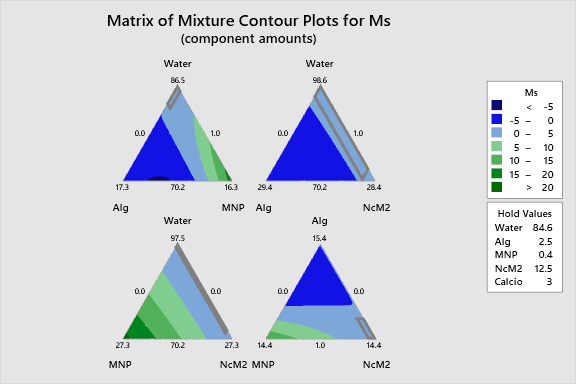
The following interactive 2D contour plots show how pairs of variables influence the response while holding the other factors at constant levels. These maps are essential for identifying optimal regions in the formulation space.
Specifically, the plot for Alginate vs. MNP reveals a critical region. The highest Ms values (red zones) are concentrated where MNP is maximized and Alginate is minimized. As you move towards the upper right of the plot (high Alginate, high MNP), the response drops rapidly due to the -164.1 coefficient, visualizing the strong interference effect.
Alg Vs Mnp Ms
Alg Vs Ncm2 Ms
Mnp Vs Ncm2 Ms
3D Surface Plots
The following interactive 3D surface plots visualization provides a topographical view of the response surface. The topology exhibits a distinct ridge rising towards the vertex associated with higher MNP concentration.
The curvature of the surface is pronounced, illustrating the non-linear blending effects. The surface dips significantly where Water and Alginate interact with MNP, creating a "saddle" or valley effect that must be avoided to maintain high magnetic saturation. To maximize Ms, the formulation must ride the gradient towards the boundary defined by low Alginate and high MNP.
3D representations of the response surface.